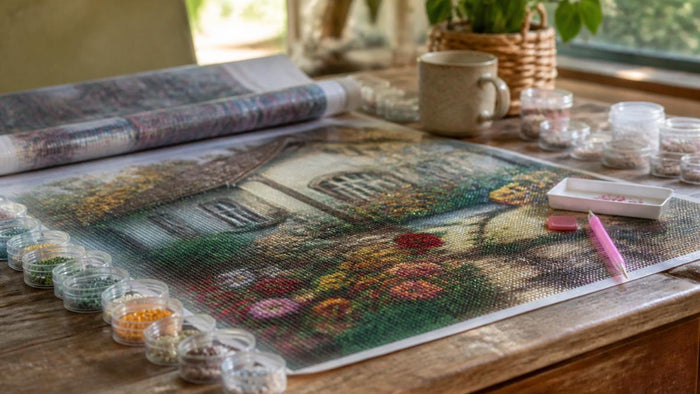
Diamond Painting Drill Types: Round, Square, AB, Special Drills
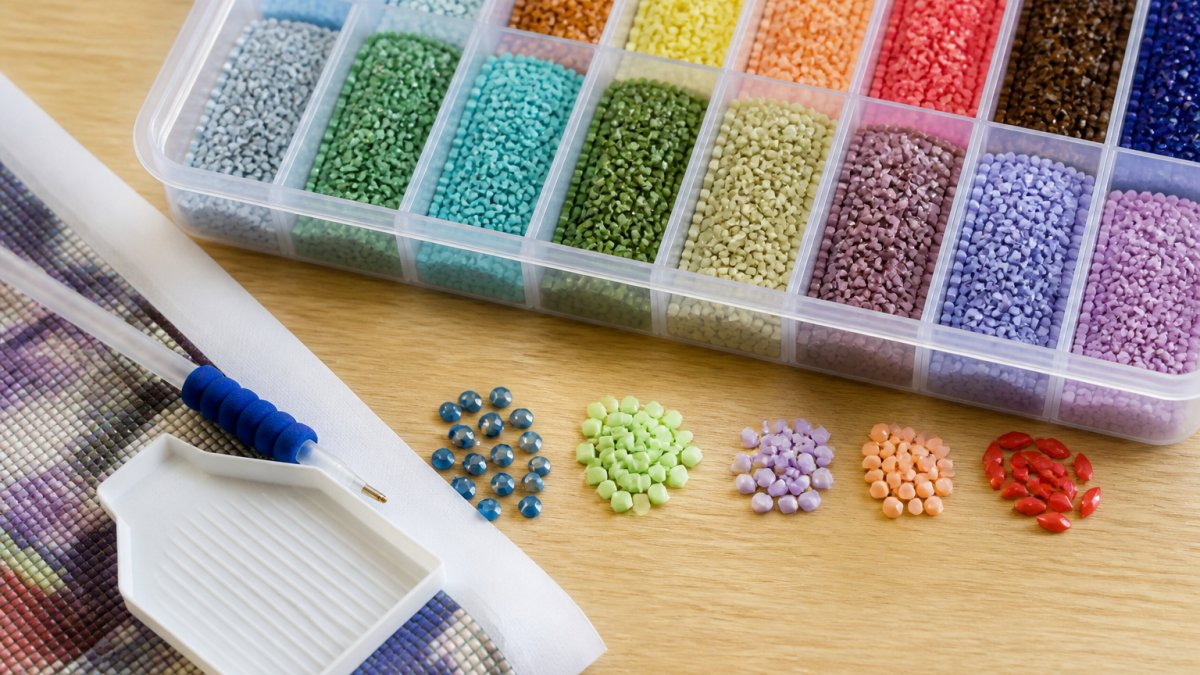
Diamond painting drills are the small faceted pieces you press onto an adhesive canvas, one for each printed symbol. Kit listings describe them in several ways: round or square, standard or AB, resin or acrylic, plus specialty finishes such as metallic and glow-in-the-dark. Knowing what each term means makes it easier to read a listing, pick a kit you will enjoy and order the right refills when a color runs short.
We're Jeanne Argent, a small studio in Alexander, North Carolina. We sell full-drill diamond painting kits with DMC-coded drills, most of them in round drills and a few in square, along with DMC-numbered round replacement drills. We do not sell AB, metallic or glow-in-the-dark drills, so the sections on those finishes are general background to help you read any listing.
Quick answer: Diamond painting drills come in two shapes: round drills, which seat easily and leave tiny spaces between stones, and square drills, which sit edge to edge for a tiled finish but need careful alignment. They also come in different finishes: standard faceted drills, AB drills with an iridescent coating that shifts color as you move, and specialty finishes such as metallic and glow-in-the-dark. The kit listing tells you the drill shape, and the canvas legend pairs each symbol with its color code.
What diamond painting drills are
A drill is a small molded plastic piece with a flat back and a faceted top. The flat side goes down onto the adhesive canvas, and the facets face up to catch the light. Crafters also call them diamonds, gems or stones; the words mean the same thing.
Each drill color has a code. Most kits use DMC numbers, a color numbering system borrowed from embroidery floss, and the legend printed on the canvas pairs every symbol with a DMC number. Our kits come with DMC-coded drills, so you match the DMC number on each drill packet to the number on the legend. If the symbols and codes are new to you, our guide on how to read diamond painting symbols and DMC codes walks through the legend step by step.
Drills differ in three ways: shape (round or square), finish (standard, AB or a specialty finish) and the plastic they are molded from (usually listed as resin or acrylic). Shape matters most, because every canvas is printed for one shape.
Round vs square drills

Round drills are circular when seen from above. They pick up easily, seat without much fuss and forgive a placement that is slightly off, which is why the listing for our Cottage Garden kit calls round the beginner-friendly shape and notes that the small gaps between round drills do not show. On a full-drill canvas every symbol is still covered; the only difference is the small space between neighboring stones.
Square drills sit edge to edge like tiles, so the finished surface reads as a tight mosaic with no gaps between stones. The trade-off is precision. A square drill set crooked shows, and you will straighten rows as you go, which is why our Owl kit listing describes square drills as less forgiving than round.
Because the symbol grid is sized for one shape, you cannot finish a square-drill canvas with round drills, or the other way around. For a fuller side-by-side, read our square vs round drill comparison.
Full drill vs partial drill: coverage, not a drill type
Full drill and partial drill describe the canvas, not the drill. A full-drill canvas is covered edge to edge with drills, while a partial-drill canvas has drills only on the main subject and leaves a printed background showing. We sell full-drill kits, and our full drill vs partial drill comparison covers how the two differ in look and effort.
Standard drills
Standard drills are the regular faceted drills in a solid color, and they make up most or all of the drills in a typical kit. Each one has a set of flat facets on top that reflect light at slightly different angles, which is where the sparkle comes from.
With standard drills, consistency matters more than any label. Drills of even size sit in straight rows, and drills with clean facets and flat backs seat firmly and reflect evenly. When you patch a canvas, the cut matters as much as the color: a drill with a different cut can catch the light differently from its neighbors, so a patch made with mismatched drills may stand out.
AB drills: what AB means
AB stands for aurora borealis. An AB drill has an iridescent coating on its faceted top that throws a rainbow sheen, and the color it shows shifts as you or the light move. The same name is used for iridescent finishes on glass beads and rhinestones.
AB drills are usually used as accents rather than across a whole canvas, in places where shimmer suits the subject, such as water, snow, stars, wings or highlights. In a kit that includes them, the legend lists each AB color as its own entry, separate from the standard drill of a similar shade.
A few practical points if you work with AB drills:
- Sort them into their own labeled containers. Under a bright lamp an AB drill and a standard drill of a similar color can be hard to tell apart.
- Look at the finished area under the light where the piece will hang. The shimmer shows most under direct light and less under soft, diffuse light.
- If you plan to seal the finished piece, test the sealer on a corner first and keep coats thin, since any coating over AB drills changes how they reflect light and can soften the color shift.
For more on how drill choice, lighting and finishing affect shine, see our guide to making a diamond painting sparkle more.
Specialty drills: metallic, glow-in-the-dark and other finishes
Specialty drills cover any finish beyond standard and AB. They are usually sold as accents or included in kits designed around them. The names are not standardized and vary from seller to seller, so read the description and look at the photos to see what a listing actually contains.
Metallic drills
Metallic drills have a reflective, metal-look finish in tones such as gold, silver or copper. They suit borders, lettering, frames drawn into the design and jewelry details. A reflective surface also makes any tilt easier to see, so take a little more care keeping metallic drills flat and in line.
Glow-in-the-dark drills
Glow-in-the-dark drills contain a pigment that absorbs light and then gives it back as a soft glow when the room is dark. They need light to charge: after time in light they glow, and the glow fades gradually in the dark until they are exposed to light again. Their daytime color can look quite different from their glow, so check the listing photos for both. A piece with glow drills shows them off best in a room that gets light during the day and goes dark at night.
Crystal, holographic and other finishes
You will also see listings for clear or crystal drills, holographic drills and drills with glitter or other effects inside. Some partial-drill kits use special-shaped drills or larger rhinestones, in shapes such as stars, hearts or teardrops, for accents. Because these terms are not standardized, compare photos rather than names.
Mixing finishes and shapes
Finishes can mix on one canvas: a pattern may use standard drills for most of the picture and AB or specialty drills for a few colors, each listed separately in the legend. Shapes generally cannot mix within the same grid, because the canvas is printed for one drill shape and size. If you want to add specialty drills to a kit that did not come with them, swap them in for a single color, keep the same shape as the rest of the canvas, check that their size matches your kit's drills and try a small area first.
Resin vs acrylic drills
Drill listings usually name one of two materials: resin or acrylic. Both are plastics, and sellers use the terms loosely. A listing rarely says exactly which plastic was used or how the drills were made, so the material name on its own tells you little about how a drill will look or last.
It is more useful to judge drills by what you can see and feel:
- Even size. Drills from the same packet should be the same size, so rows stay straight and drills sit flush with their neighbors.
- Clean facets. Look for crisp facets without rough edges or leftover bits of plastic from the mold.
- Flat backs. A flat back seats fully into the adhesive. A drill with an uneven back can rock and lift.
- Consistent color. Drills in one packet should match each other, and refills should match the shade already on your canvas.
Because drills from different sources can differ slightly in size and cut, it is best to finish a canvas with the drills it came with. When you do need extras, match the shape and DMC number exactly, and compare a few refill drills with the ones already on your canvas before you fill a large area.
What keeps drills on the canvas
Drills do not hold themselves in place; the adhesive on the canvas does. That is why two canvases with similar drills can behave very differently. A few habits help any drill type stay put:
- Peel back the release film only over the area you are working on, and lay it back down when you stop, so the adhesive stays clean.
- Pick up each drill flat side down and press it straight onto its symbol, then press finished sections again with a flat, clean object.
- Keep dust, lint and pet hair off exposed adhesive.
Our guide to canvas adhesive quality explains what affects how well a canvas holds, and why diamond painting drills pop off covers the common causes and fixes. If you want extra protection once the piece is done, see how to seal a diamond painting.
Running short: DMC codes and replacement drills
A kit comes with the drills its pattern needs, but a few drills lost under the couch or a heavy hand with one color can still leave you short near the end. Here is how to replace them:
- Find the symbol on the canvas legend and note its DMC number.
- Check your drill shape. Round and square drills are not interchangeable.
- Order the same shape and DMC number. For our kits and other round-drill canvases, our DMC round replacement drills in screw-top jars come one color per jar, about 1,500 drills each by the listing's estimate, and our DMC-numbered round replacement drill packets hold smaller amounts that vary from packet to packet.
- Before filling a large area, set a few new drills next to the old ones and compare color and cut.
Our refills are round only, so they will not fill a square-drill canvas. Our drill storage and organization ideas help keep leftovers sorted by DMC number for next time, and if you already have gaps or wandering rows, our guide on how to fix and prevent gaps covers the fixes.
Which drill type should you choose?
For a first kit
Start with a smaller full-drill kit in round drills. Round drills forgive small placement errors, and a smaller canvas lets you finish while the project still feels fresh. Our budget and beginner kits are a good place to look. For example, our Cottage Garden kit is a 40 x 40 cm canvas in round drills, and its listing estimates roughly 15 to 20 hours. If you are brand new to the craft, our beginner's guide to diamond painting covers what comes in a kit and how to set up.
When you want a sharper, tiled finish
Move to square drills once straight rows feel natural. A mid-size canvas such as our Lakeside Cottage in Spring kit (40 x 50 cm, square drills) is a gentler step than a large one; its listing estimates roughly 20 to 25 hours. Our Owl kit is a 60 x 80 cm square-drill canvas with 48 DMC colors; its listing estimates roughly 45 to 60 hours and says plainly that it is not a first kit.
When you want extra shimmer
Look for a pattern built around AB or specialty drills, and check the listing for which colors use them. Starting with a design that uses them as accents lets you see how you like the effect before committing to a whole canvas of it.
Placement tips for each drill type
- Round drills: Do not chase every tiny space between stones; round drills are meant to sit that way. Put your attention on keeping rows straight.
- Square drills: Work in short rows and check alignment every few rows. A ruler or drill straightener helps nudge a row back into line.
- AB and metallic drills: Set them flat and square to the grid, since reflective finishes make any tilt easier to see.
- Every type: Keep your drills sorted by DMC number and finish so a stray drill never ends up in the wrong tray.
Our drill placement tips go further, including how to keep long rows from drifting.
Diamond painting drill types at a glance
| Type | What it is | Good to know |
|---|---|---|
| Round | Circular drill with a faceted top | Easy to place; small spaces between stones; still full coverage on a full-drill canvas |
| Square | Square drill that sits edge to edge | Tiled, gap-free look; needs careful alignment |
| Standard | Solid-color faceted drill | Makes up most kits; look for even size and clean facets |
| AB | Drill with an iridescent aurora borealis coating | Color shifts with the viewing angle; used as accents; sort separately |
| Metallic | Drill with a reflective, metal-look finish | Suits borders and details; shows any tilt |
| Glow-in-the-dark | Drill with a pigment that glows after light exposure | Needs light to charge; the glow fades in the dark |
Frequently asked questions
What are the main types of diamond painting drills?
Drills come in two shapes, round and square, and in several finishes: standard, AB and specialty finishes such as metallic and glow-in-the-dark. Listings also name the material, usually resin or acrylic, though the shape and finish affect your project far more than the material name.
What does AB mean in diamond painting?
AB stands for aurora borealis. It is an iridescent coating that gives a drill a rainbow sheen that shifts with the viewing angle. In kits that include AB drills, each AB color has its own entry in the legend.
Are round or square drills better for beginners?
Round drills are usually easier for a first kit because they seat easily and small placement errors do not show much. Square drills give a sharper, tiled finish but need more care with alignment, so many people try them on a mid-size canvas once they are comfortable.
Do glow-in-the-dark drills need light to work?
Yes. Glow drills absorb light and release it as a glow in the dark. Keep the finished piece somewhere it gets light, and expect the glow to fade gradually after the lights go out.
Are resin drills better than acrylic drills?
Not necessarily. Both are plastics, and sellers use the names loosely. Judge drills by even size, clean facets, flat backs and consistent color rather than by the material named on the listing.
Can I use round drills on a square-drill canvas?
No. The symbol grid is sized for one drill shape, so round drills will not fill a square-drill canvas properly, and square drills will not fit a round-drill grid. Always replace drills with the same shape your canvas uses.
What should I do if I run out of a drill color?
Find the symbol on the legend, note the DMC number and your drill shape, and order a refill in that exact shape and number. Compare a few new drills with the ones already on the canvas before you fill a large area.
Shop round and square kits and replacement drills
- Round replacement drills in screw-top jars: one DMC color per jar, about 1,500 round drills, with the DMC number on the label.
- Round replacement drill packets: DMC-numbered round drills sorted from kits that could not be sold complete; fill levels vary.
- Owl square-drill kit: a 60 x 80 cm full-drill canvas in square drills with 48 DMC colors.
- Lakeside Cottage in Spring kit: a 40 x 50 cm full-drill canvas in square drills.
- Budget and beginner kits: smaller kits for a first project, including round-drill canvases and framed kits for kids.