1 August 2026
Avoiding Eye Strain Diamond Painting: A Complete Guide
Table of Contents
- Why Eye Strain Happens During Diamond Painting
- Best Lighting for Diamond Painting
- Magnifying Tools for Diamond Painting
- Setting Up an Ergonomic Workstation to Reduce Eye Strain
- Taking Breaks Diamond Painting: The 20-20-20 Rule
- Eye Exercises for Diamond Painting Sessions
- Managing Blue Light Exposure and Color Contrast
- Common Mistakes That Increase Eye Strain
Avoiding Eye Strain Diamond Painting: A Complete Guide
Last Updated: August 2, 2026
Diamond painting has become one of the most popular screen-free creative hobbies in the United States, offering a meditative escape from digital fatigue. Yet many crafters discover that avoiding eye strain diamond painting requires deliberate setup that protects vision while you work. This guide covers the practical strategies that separate a comfortable, sustainable diamond painting practice from one that leaves you squinting and fatigued.
The challenge isn't that diamond painting inherently damages your eyes. It's that most people approach the hobby with a setup designed for casual crafting rather than the precise, detail-oriented work that diamond painting demands. Small drills, tiny symbols on canvas, and hours of focused attention create a perfect storm for eye strain if your environment isn't intentional.
Why Eye Strain Happens During Diamond Painting
Eye strain during diamond painting occurs because your eyes work at near focal distance for extended periods, tracking minute details and maintaining intense focus on symbols and drills. This constant convergence fatigues the ciliary muscles that control lens shape. Add inadequate lighting, and your pupils dilate to compensate, forcing the eye to work even harder.
The problem compounds when poor positioning combines with glare, reflections, or insufficient contrast between canvas symbols and background. Many hobbyists work under overhead ceiling lights that create shadows or use natural window light that shifts throughout the day. Your eyes adapt constantly, triggering fatigue. Over hours, this leads to blurred vision, headaches, dry eyes, and aching behind the eyeballs.
Posture compounds the problem. Many crafters hunch over their canvases, placing their eyes closer than optimal focal distance and tilting their heads forward. This strains not just the eyes but the neck and shoulders.
The good news: eye strain during diamond painting is almost entirely preventable with intentional setup choices.
Best Lighting for Diamond Painting
Lighting is the single most important factor in avoiding eye strain diamond painting. Your eyes need sufficient brightness to see symbols clearly without squinting, and that light must come from the right direction and color temperature to minimize glare and reflections.
Choosing the Right Light Source
The ideal light source combines three qualities: brightness (measured in lumens), color temperature (measured in Kelvin), and flicker-free operation.
Lumens and brightness: You need between 500-1000 lumens directly on your canvas, roughly equivalent to a 60-75 watt incandescent bulb achieved more efficiently with LED. This brightness allows your pupils to remain at a comfortable diameter, reducing eye strain. Too dim, and your pupils dilate excessively; too bright, and you create glare.
Color temperature: Daylight-balanced LED lamps (5000-6500 Kelvin) most closely match natural sunlight and reduce the need for your eyes to adapt between your work and surrounding environment. For diamond painting, prioritize daylight temperature.
Flicker-free operation: Many budget LED lights flicker at imperceptible frequencies, which your eyes detect even when your brain doesn't consciously register it. This flicker causes fatigue over hours. Look for lamps explicitly labeled "flicker-free" or "high frequency ballast."
A daylight LED lamp designed for crafting or task work typically meets all three criteria and often includes adjustable brightness and color temperature options.
Positioning Your Light Pad or Light Board
Many serious diamond painters use a light pad or light board, a flat panel with built-in LED illumination that sits directly beneath the canvas. The light comes from behind the canvas, illuminating symbols from underneath, which increases contrast and makes drills easier to see.
If you choose a light pad, ensure it offers adjustable brightness. Start at a moderate level, around 60-70% brightness, rather than maximum. Position the light pad so that the canvas sits at least 12-18 inches from your eyes. This distance allows your eyes to focus comfortably without excessive accommodation.
Pair your light pad with a separate overhead light source as well. The light pad illuminates the canvas, but ambient room lighting prevents your eyes from adapting to a single bright spot surrounded by darkness, which creates additional fatigue.
Magnifying Tools for Diamond Painting
Magnification is your second line of defense against eye strain. By enlarging the drills and symbols, you reduce the accommodation demand on your eyes and allow you to work from a slightly greater distance, which is more ergonomically comfortable.
Magnifying glasses or clip-on magnifiers (typically 3x-5x magnification) are the most popular choice for diamond painting. They mount directly to your work surface or glasses, keeping your hands free and maintaining consistent magnification as you move across the canvas. A 3x magnifier enlarges symbols to about three times their actual size, enough to reduce strain without making the canvas feel distorted.
Some crafters prefer magnifying lamps, which combine a magnifying lens with integrated LED lighting. These eliminate the need for a separate light source and magnifier, though they're more expensive and take up more workspace.
Prescription vs. Non-Prescription Magnification
If you wear glasses or contacts for distance vision, non-prescription magnifiers typically work well. A 3x-5x magnifier enlarges the work enough that small refractive errors become irrelevant. However, if you wear progressive bifocals, you may find that non-prescription magnifiers don't work well.
Prescription magnification is a specialized option: glasses designed specifically for near-distance work, with a prescription optimized for the focal distance of diamond painting (typically 12-16 inches). If you spend 10+ hours per week on diamond painting and have existing vision correction needs, prescription magnification glasses can reduce strain significantly. These are available through optometrists and specialized lens makers.
If you don't currently wear glasses, a non-prescription magnifier is the right choice. If you do wear glasses or contacts, start with a clip-on magnifier or magnifying lamp.
Setting Up an Ergonomic Workstation to Reduce Eye Strain
Your workspace layout determines whether your eyes, neck, and shoulders experience strain. A proper diamond painting setup positions the canvas at the right distance, angle, and height relative to your eyes.
Canvas Tilt and Adjustable Stand Positioning
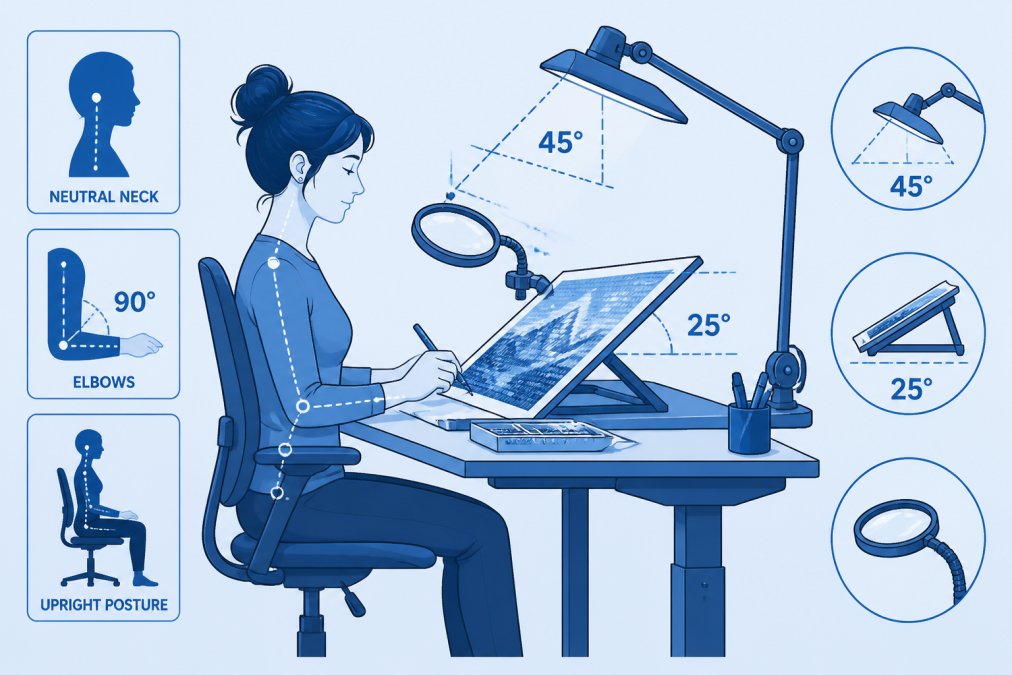
Your canvas should sit at a 20-30 degree angle from horizontal, tilted slightly toward you. This angle reduces the distance between your eyes and the canvas compared to a flat surface, while still allowing you to see the entire canvas without excessive head movement.
An adjustable stand or easel lets you fine-tune this angle to your preference. Your canvas should also sit at eye level or slightly below. If you're working at a table, position the canvas so that the center of the work sits at about 15-20 degrees below your horizontal gaze line. This prevents the forward head tilt that creates neck strain and indirectly contributes to eye fatigue.
The ideal viewing distance is 12-18 inches from your eyes to the canvas. At this distance, your eyes can focus comfortably while maintaining good posture. If you find yourself leaning in closer, that's a signal that your lighting or magnification isn't sufficient.
Reducing Glare and Reflections
Glare occurs when light reflects directly off the canvas surface into your eyes. This is especially problematic with glossy or semi-gloss canvas finishes. Reflections reduce contrast and force your eyes to work harder to distinguish symbols.
Position your light source so that reflected light bounces away from your eyes, not toward them. The 45-degree angle mentioned earlier accomplishes this. If you still experience glare, try angling your canvas slightly so that reflections miss your line of sight.
Some crafters place a matte anti-glare screen or filter over their canvas to reduce reflections. These are inexpensive and effective, though they slightly reduce brightness. Ambient room lighting also matters. Dim overhead lights when you're working, or position your workspace so that bright light sources are to your side rather than behind you.
Taking Breaks Diamond Painting: The 20-20-20 Rule
Even with perfect lighting, magnification, and posture, your eyes need regular breaks from the focused accommodation demand of diamond painting. The 20-20-20 rule is simple and evidence-based: every 20 minutes, take a 20-second break and focus on something at least 20 feet away.
This break allows the ciliary muscles controlling your lens to relax and your eyes to reset their accommodation. Look out a window, focus on a far wall, or gaze across the room. The key is distance; anything beyond about 20 feet engages your distance-vision muscles and gives your near-focus muscles a genuine break.
Most crafters find that taking breaks every 20 minutes becomes natural with practice. Some use a timer or phone app to remind them. Beyond the 20-20-20 rule, take a longer 5-10 minute break every 60-90 minutes of continuous work. During this break, step away from your workspace, move around, and let your eyes adjust to a broader visual environment.
Eye Exercises for Diamond Painting Sessions
Beyond the 20-20-20 rule, targeted eye exercises during breaks can further reduce strain and improve comfort.
Visual Ergonomics Exercises to Relax Eye Muscles
Accommodation relaxation: Focus on a distant object for 10 seconds, then shift focus to something nearby (6-12 inches away) for 10 seconds. Repeat 5-10 times. This trains your ciliary muscles to move fluidly between distances.
Palming: Rub your palms together to warm them, then gently cup them over your closed eyes without applying pressure. The warmth and darkness relax your eyes and reduce tension. Hold for 30-60 seconds, then slowly open your eyes.
Figure-eight tracking: Imagine a large figure-eight pattern in front of you (about 3 feet away). Slowly trace the pattern with your eyes, moving smoothly and deliberately for 30-60 seconds. This engages your eye muscles in a different pattern than diamond painting.
Blinking practice: During diamond painting, you blink less frequently than normal, contributing to dry eyes and strain. Consciously blink slowly and deliberately 10 times, focusing on a complete closure of your eyelids. This distributes tears across your eye surface.
These exercises take 2-3 minutes total and can be done during your 5-10 minute breaks.
Managing Blue Light Exposure and Color Contrast
Blue light, the short-wavelength light emitted by LED sources, can contribute to eye strain, especially during evening crafting sessions. If you craft in the evening, consider using a light source with slightly warmer color temperature (4000-5000K instead of 6500K), or wear blue-light-filtering glasses while working.
Color contrast also affects eye strain. Drills and symbols should have clear contrast against the canvas background. If your kit uses low-contrast symbols, the visual search becomes harder and eye strain increases. When choosing between kits, inspect the symbol contrast before purchasing. Hold the canvas at your normal working distance and see if symbols are immediately visible or require squinting. High contrast is a sign of a well-designed kit.
Common Mistakes That Increase Eye Strain
Understanding what doesn't work is as important as knowing what does. Here are the most common setup mistakes that increase eye strain:
Working without magnification. Even if symbols are visible without magnification, adding a 3x magnifier cuts eye strain significantly by reducing accommodation load.
Using only overhead lighting. Ceiling lights create shadows across your canvas and force your eyes to constantly adapt. Always pair overhead lighting with a task light positioned specifically at your workspace.
Positioning the canvas too close. Leaning in increases accommodation demand. Maintain at least 12 inches between your eyes and the canvas.
Skipping breaks. The most common mistake is losing track of time and working for 2-3 hours without a break. Set a timer. The 20-20-20 rule works only if you actually follow it.
Poor posture. Slouching or hunching forward shifts your eyes closer to the canvas and strains your neck. Sit upright with your shoulders relaxed and your back supported by your chair.
Working in dim lighting. Dim lighting forces your pupils to dilate and your eyes to work harder. Proper brightness, 500-1000 lumens, reduces eye strain significantly.
Avoiding eye strain diamond painting comes down to intentional choices about lighting, magnification, posture, and breaks. The setup takes time to optimize, but once in place, it transforms diamond painting from a tiring activity into a genuinely restorative hobby.
If you're serious about completing multiple kits comfortably, Jeanne Argent Atelier's premium full-drill kits pair beautifully with a well-designed workspace. The high-contrast symbol printing and quality canvas reduce the visual demand on your eyes, while specialized drill pens and trays minimize hand fatigue. Start with one of our collections, invest in proper lighting and magnification, and commit to the 20-20-20 rule. You'll notice the difference within your first session.
Frequently Asked Questions
What causes eye strain when diamond painting?
Eye strain during diamond painting results from sustained focus on small symbols and drills, poor lighting that forces your eyes to work harder, and extended sessions without breaks. The combination of close-range work, dim or uneven lighting, and repetitive eye movements can fatigue the ciliary muscles that control focus. This is especially true if your canvas symbols have low contrast or if you're working in dim lighting without magnification support.
How does the 20-20-20 rule help prevent eye strain?
The 20-20-20 rule directs you to take a break every 20 minutes, look at something 20 feet away, and focus there for 20 seconds. This gives your eye muscles a chance to relax from the constant close-range focus required for diamond painting. Distant vision uses different focal lengths and allows the ciliary muscles to reset, reducing fatigue and preventing the headaches and blurred vision that come with prolonged eye strain.
What type of lighting is best for avoiding eye strain while diamond painting?
Daylight LED lamps with a color temperature between 5000-6500K and flicker-free output work best for diamond painting. These provide consistent, bright illumination without the flicker that causes eye fatigue. A light pad positioned above and slightly to one side of your canvas reduces glare while delivering even ambient lighting across your work surface. Avoid dim lighting or relying solely on overhead room lights, which force your eyes to strain to see small drill details.
Can magnifying glasses really reduce eye strain during diamond painting?
Yes. Magnifying glasses enlarge the symbols and drills on your canvas, reducing the amount of accommodation (focusing) your eyes must do. This decreases eye muscle fatigue significantly during long sessions. Prescription magnification tailored to your vision correction needs is most effective, but non-prescription magnifying glasses also help many crafters. Choosing the right focal length and magnification strength for your eyesight makes a measurable difference in comfort and reducing visual fatigue over hours of work.
This article was written using GrandRanker