1 September 2026
Best Diamond Painting Light Pads for Detailed Work
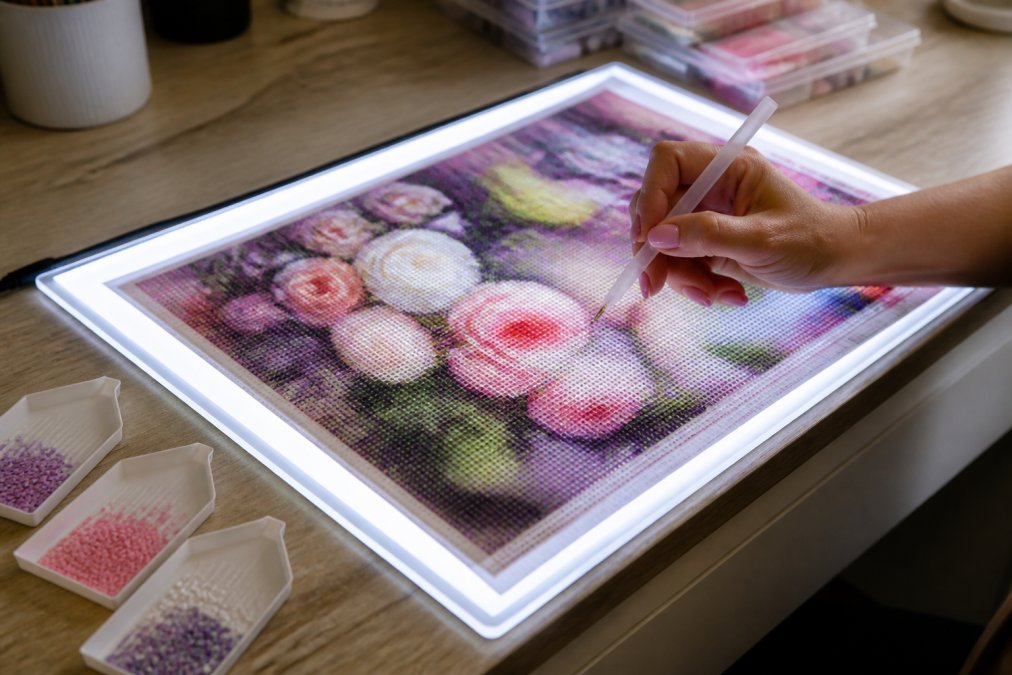
Table of Contents
- What Makes a Light Pad Essential for Diamond Painting
- Dimmable LED Light Pad for Diamond Painting: Finding the Right Brightness
- How to Reduce Eye Strain Diamond Painting with Proper Lighting
- A3 vs A4 Light Pad for Diamond Art: Size and Coverage Comparison
- Power Source and Portability: USB vs Rechargeable Options
- Durability and Long-Term Performance for Serious Crafters
- Ergonomic Setup and Workspace Organization
- Conclusion
- Frequently Asked Questions
Last Updated: September 2, 2026
What Makes a Light Pad Essential for Diamond Painting
A light pad is the difference between completing a project with joy and abandoning it in frustration. When placing thousands of tiny rhinestones, visibility determines everything. Poor lighting forces squinting, eye strain, and placement errors that compound across the entire piece.
Canvas symbols are small, and natural or overhead lighting creates shadows and glare that make them nearly impossible to read accurately. A proper light pad sits directly under your canvas, eliminating shadows and providing consistent, flicker-free illumination that shows exactly where each drill belongs.
At Jeanne Argent Atelier, we understand that serious crafters don't settle for mediocre tools. The kits we design include specialized drill pens and trays that work best when paired with quality lighting. Your workspace setup directly impacts how much you'll enjoy the creative process and how professional your finished piece will look.
Size, brightness levels, power source, and durability all affect your experience. A cheap pad might work for a small project, but when committing 40+ hours to a detailed canvas, investing in a reliable light pad pays dividends in comfort, accuracy, and completion rates.
Dimmable LED Light Pad for Diamond Painting: Finding the Right Brightness
The ability to adjust brightness is essential for different canvas types and personal preferences. A dimmable LED light pad lets you fine-tune illumination based on what you're working on. Darker backgrounds need more light penetration; metallic or holographic drills can create glare if brightness is too high.
Flicker-free LED technology prevents eye fatigue during extended sessions (peer-reviewed research). Flickering lights, even at imperceptible frequencies, cause cumulative strain that leads to headaches and blurred vision.
Look for pads with at least three brightness levels, though stepless dimming offers superior control. The ARTDOT A4 LED Light Pad provides three distinct levels. The Huion L4S offers stepless adjustment and a memory function that remembers your preferred brightness.
Most quality diamond painting pads range from 2,000 to 5,500 lux (cie.co.at). Mid-range brightness (around 3,500 lux) works well for most canvases without eye strain. Excessive brightness can make metallic drills harder to place because of glare.
Cooler white light (around 5,000K color temperature) reveals symbol details more clearly than warm light, which can make small symbols blend together.
How to Reduce Eye Strain Diamond Painting with Proper Lighting
Eye strain stems from insufficient light forcing squinting, flickering that causes sustained tension, and improper viewing angles that strain neck and eye muscles. A quality light pad addresses all three.
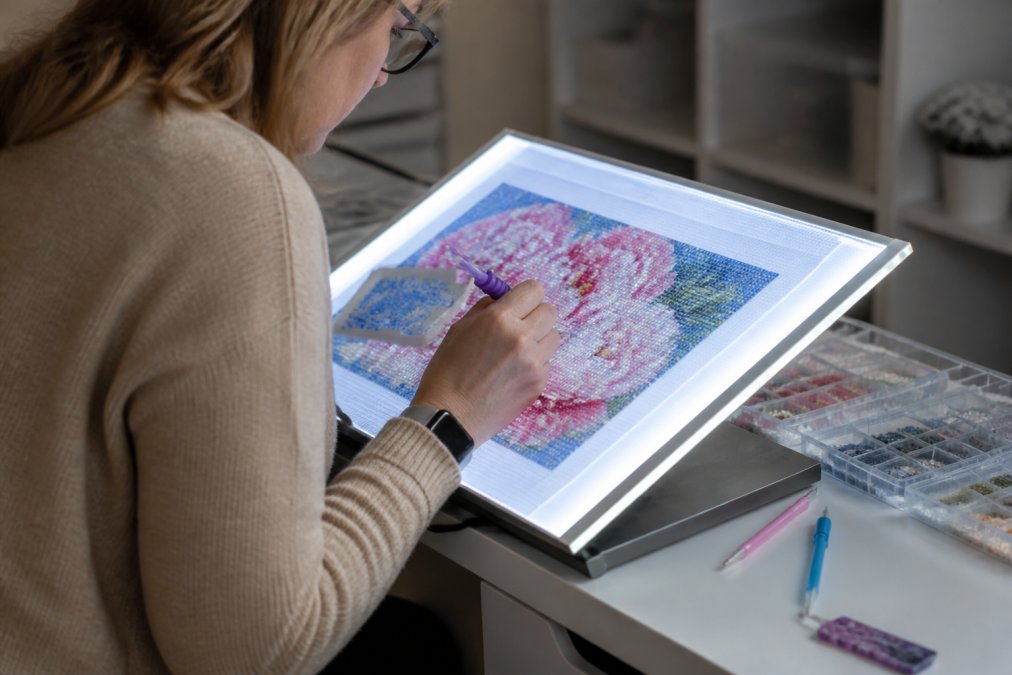
Flicker-free LED technology is essential for hours-long sessions. Traditional incandescent or fluorescent lights flicker at 50-60 Hz, triggering sustained muscle tension around the eyes. LED pads designed for detailed work eliminate this problem entirely.
Position your pad at roughly a 20-30 degree angle, not flat. This reduces glare and allows light to illuminate canvas symbols without bouncing back into your eyes. The pad should be close enough that the lit area covers your entire working zone.
Your canvas should sit 12-16 inches from your eyes when seated comfortably (osha.gov). At this distance, your eye muscles work in their natural focal range. Too close causes over-focusing; too far causes strain.
Take breaks every 45-50 minutes. Step away, look at something distant for 30 seconds, and let your eye muscles reset.
A3 vs A4 Light Pad for Diamond Art: Size and Coverage Comparison
Size determines how often you reposition your canvas and how much of your working area stays illuminated.
| Aspect | A4 Size (13.2" × 9.3") | A3 Size (16.5" × 11.7") |
|---|---|---|
| Best For | Small to medium canvases, portable work | Medium to large canvases, stationary setups |
| Repositioning | Frequent (every 15-20 minutes) | Less frequent (every 30+ minutes) |
| Workspace Footprint | Compact, fits small desks | Larger, requires dedicated space |
| Portability | Lightweight, easy to transport | Heavier, less portable |
| Cost | Generally lower | Mid-range pricing |
| Eye Fatigue | Higher due to constant repositioning | Lower due to larger lit area |
A4 pads work well for traveling with projects or working in limited space. The ARTDOT A4 LED Light Pad and Tikteck A4 Ultra-thin Portable LED Light Box emphasize portability. You'll reposition frequently, but the compact footprint fits apartment living.
A3 pads like the Litup A3 LED Light Pad eliminate constant repositioning. For serious crafters working on detailed canvases, fewer interruptions mean better flow and fewer placement errors.
For canvases larger than A3, consider bigger options like the Artograph LightPad LX Series (up to 17" × 24") or the ME456 A2 LED Light Pad. These aren't portable but suit dedicated crafting spaces.
Your decision depends on how you work. Are you moving between locations or working in a permanent station? Do you work on small or large canvases? A4 suits mobility; A3 and larger suit stationary, serious projects.
Power Source and Portability: USB vs Rechargeable Options
Your power source determines where you can work and how much setup friction you face. USB-powered pads dominate because they're simple and affordable. Rechargeable options offer freedom but require battery management.
USB-powered pads like the ARTDOT A4, Huion L4S, and Tikteck A4 plug into a wall adapter, computer, or power bank. They're always ready with no charging cycles or battery degradation. For a dedicated crafting desk, this is zero friction. For portable work, you're tethered to an outlet or need a power bank.
Rechargeable pads like the Cricut BrightPad Go offer cordless convenience with 1.5+ hours of uninterrupted crafting. For casual work or travel, it's perfect. For serious, extended projects, you'll manage charge cycles and plan around battery life.
If you craft for 30-60 minute sessions, rechargeable works fine. If you lose yourself in a project for three hours, USB-powered prevents power loss mid-session.
Rechargeable batteries degrade over time. After 300-500 charge cycles (roughly one year of regular use), they hold less charge. USB-powered pads maintain consistent performance indefinitely.
For travel, pair a USB pad with a portable power bank for the best of both worlds.
Durability and Long-Term Performance for Serious Crafters
Durability separates casual tools from investments lasting years. If you're completing multiple large projects annually, you're looking at hundreds of hours of use.
LED lifespan is the primary durability metric. Quality pads specify 30,000 to 50,000 hours of LED life. At 50,000 hours, you could use the pad three hours daily for 45 years before LEDs degrade.
Surface durability matters more than expected. Your canvas sits directly on the pad surface, and drills can scratch cheap acrylic. The Cricut BrightPad Go specifies 6H hardness surface, resisting scratches. The Artograph LightPad LX Series uses a double-layered firm work surface for heavy use. Budget pads often use thin acrylic that scratches easily.
Cord durability is where many cheap pads fail. Quality pads use reinforced cables with strain relief at connection points.
Aluminum frames like those in the Artograph series resist warping and damage. Plastic frames are lighter but more prone to cracking if dropped.
Check warranty policies. Serious manufacturers offer one to three year warranties. If a company won't stand behind their product, that signals expected lifespan.
Ergonomic Setup and Workspace Organization
Your light pad is one part of an ergonomic crafting setup. The pad's position, your seating, and tray organization determine whether you work comfortably for hours or develop pain and tension.
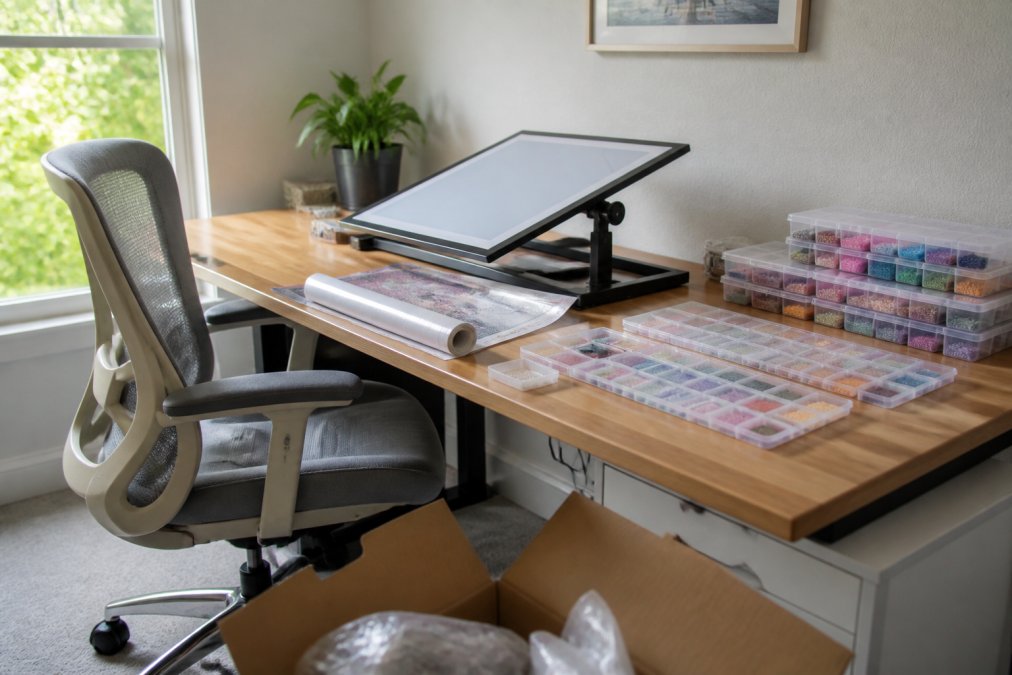
Position your pad at a 20-30 degree angle, not flat. An adjustable stand or desktop easel achieves this without propping with books.
Your seating height matters tremendously. Your feet should rest flat on the floor, thighs parallel to the ground, and elbows at roughly 90 degrees when hands rest on the pad. This neutral posture minimizes strain across shoulders, neck, and lower back.
Arm support prevents shoulder fatigue. Position your chair or desk height so your arms rest naturally on the work surface.
Organize drill trays within arm's reach. Many crafters use a tray carousel or tiered stand that keeps colors organized and accessible without reaching far.
Position a secondary light source (desk lamp or window light) to your side or behind you. This illuminates your tray area and reduces contrast between your bright pad and dark surroundings.
Keep a small table within reach for your current tray, drill pen, and wax. Every needed item should be within arm's length.
Take breaks every 45-50 minutes. Stand up, stretch, look at something distant, and walk around.
Conclusion
Choosing the best diamond painting light pads for detailed work comes down to matching your specific needs: canvas size, work duration, portability requirements, and budget. A4 pads suit casual crafters and travelers. A3 and larger pads serve serious hobbyists completing substantial projects in dedicated spaces.
Quality matters more than price alone. A dimmable LED light pad with flicker-free technology, adjustable brightness, and durable construction serves you reliably for years. The Artograph LightPad LX Series represents the professional standard with exceptional brightness range, durable aluminum construction, and 50,000-hour LED lifespans. The Huion L4S offers stepless dimming and eye-protection technology at mid-range pricing. For budget-conscious crafters, the ARTDOT A4 LED Light Pad provides solid performance and comprehensive accessories.
Pair your light pad with proper ergonomic setup: angled positioning, supportive seating, organized trays within reach, and regular breaks. This combination eliminates eye strain and prevents repetitive strain injuries that derail projects.
When ready to invest in premium diamond painting kits alongside your lighting setup, Jeanne Argent Atelier offers full-drill kits crafted from original artwork with specialized drill pens and trays designed for serious painters. The right kit, paired with quality lighting and an ergonomic workspace, transforms diamond painting from a frustrating hobby into a deeply rewarding creative practice.
The difference between completing a diamond painting project and abandoning it often comes down to your workspace setup. A quality light pad, proper ergonomic positioning, and organized materials make hours of detailed work genuinely enjoyable rather than exhausting. Jeanne Argent Atelier's premium kits are designed for crafters who take their work seriously. Pair them with reliable lighting and you'll create pieces worthy of display. Explore our curated collections and find the perfect canvas for your next masterpiece.
Frequently Asked Questions
What features should I look for in a light pad for detailed diamond painting?
Prioritize adjustable brightness to match your canvas type and reduce eye strain during long sessions. Look for flicker-free LED illumination, which is gentler on the eyes than standard lighting. Symbol visibility is critical, ensure the pad produces even, bright light across the entire work surface. For detailed work, consider a larger size (A3 or bigger) to minimize repositioning. Non-slip bases and ultra-thin designs improve workspace organization and comfort. Durable construction matters if you plan extended crafting sessions.
Do you need a light pad for diamond painting?
While not strictly required, a quality light pad dramatically improves the diamond painting experience, especially for detailed work. It enhances symbol visibility on the canvas, reducing strain and mistakes. LED light pads reduce eye fatigue during multi-hour sessions and make drill placement more precise. For serious crafters working on intricate designs, a light pad becomes essential for maintaining accuracy and comfort. Beginners often find they can complete projects faster and with fewer errors when using proper illumination.
Is a rechargeable light pad better than a corded one for long diamond painting sessions?
Rechargeable light pads offer portability and freedom from cords, but battery life typically limits extended sessions to 1.5-2 hours before needing recharge. Corded USB-powered pads provide continuous, uninterrupted power for marathon crafting sessions without battery concerns. For serious detailed work lasting several hours, corded options are more practical. Rechargeable pads excel for casual sessions or working in different locations. Consider your typical crafting duration and workspace setup when choosing between the two.
How does proper lighting improve accuracy in diamond painting?
Clear illumination makes canvas symbols sharper and easier to read, reducing placement errors and wasted drills. Flicker-free LED light reduces eye fatigue, which improves focus and precision during detail-intensive work. Adjustable brightness lets you optimize visibility for different canvas densities and drill types, thicker materials require brighter light. Better lighting also reduces the need to reposition your canvas constantly to find symbols, keeping your workflow smooth and maintaining accuracy across the entire project.
This article was written using GrandRanker