Why Diamond Painting Rows Drift, and the Three Tools That Stop It
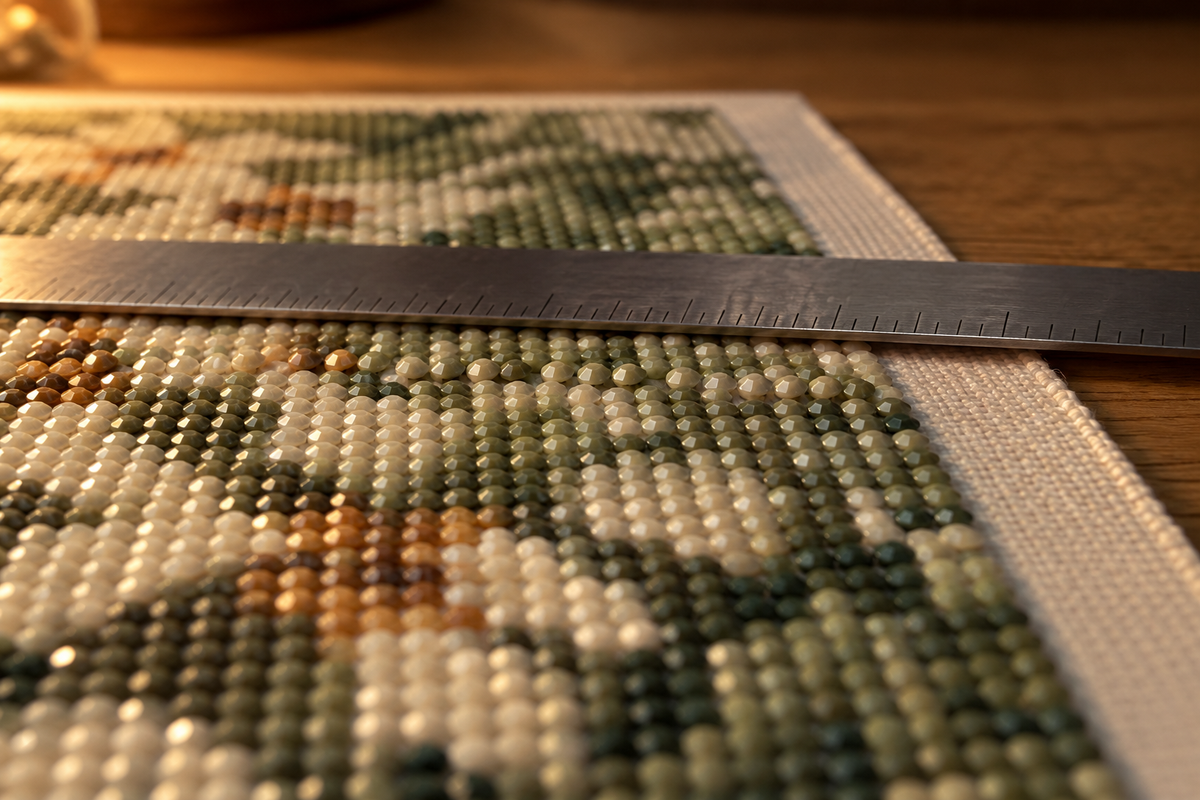
Hold a finished canvas up next to a lamp and look along the surface at an angle rather than straight down at it. Two faults show up that you cannot see from directly above: drills sitting proud of their neighbours, each throwing its own small shadow, and rows that wandered a millimetre somewhere in the middle and never came back.
Both are fixable. Neither is fixable by being more careful, which is the advice you usually get.
Drift is a compounding error, not a placement error
Nobody places a drill visibly crooked. What happens is that you place one a fraction of a millimetre left of centre, and then you use that drill as the reference for the next one, and the next. By the time you are forty drills along, the row has walked. The error was never big enough to notice at the moment you made it — it only became visible after it was repeated.
This is why "go slower" does not help. Slowing down makes each individual placement marginally better and does nothing about the compounding, because you are still referencing the last drill rather than a fixed line.
A straight edge laid across the row breaks the chain. You are no longer measuring against the previous drill, you are measuring against something that cannot itself drift. That is the entire mechanism, and it is why a small piece of shaped plastic outperforms an hour of concentration.
Corners are a different problem
Edges and corners are where drift becomes obvious to anyone looking at the finished piece, because a straight border gives the eye something to judge against. A row in the middle of a forest can wander and read as texture. The same wander along the outer edge reads as a mistake.
Large canvases are the worst for this, since there is more straight line to go wrong and more distance over which a small angle opens up. A right-angle tool is doing something a straight ruler cannot: holding two directions true at once, so the corner stays square instead of slowly becoming a parallelogram.
The straightener is about adhesive, not alignment
The third tool gets misunderstood. A slide straightener does not fix crooked rows. What it does is press a finished section flat so every drill seats fully into the adhesive rather than perching on top of it.
Two things follow from that. The obvious one is that drills stop popping off weeks later. The less obvious one is photographic: a canvas where every facet sits at the same height catches light as one surface. A canvas where they sit at slightly different heights scatters it, and looks dull in photos no matter how good the drills are. If your finished pieces never photograph as well as they look in person, this is usually why.
What none of this fixes
A row already set crooked stays crooked. The adhesive on most canvases is strong enough that lifting and re-placing a run of drills damages the surface more than the wobble did. Tools are preventative — they keep the next hundred rows straight, not the last hundred.
Gapping is the same story. A straightener improves how well drills sit, but it cannot close a gap that exists because the drills are slightly undersized for the grid. If you can see canvas between your rows, that is a materials problem, not a technique problem.
What I sell, and the honest comparison
I stock two versions of the same three-piece set.
The imported plastic set is the inexpensive one. It does the job. If you have never used alignment tools and want to find out whether they change anything for you, start there.
The set I print in my own studio is a couple of dollars more, and the difference is the finish. It is printed in silk PLA, which comes off the plate slick rather than with the fine tooth a matte print has — that matters on the face of a straightener, where any texture catches on the edges of the drills instead of gliding over them. It also comes in eight colours, each with a metallic or pearl sheen, which sounds cosmetic until you set a tool down on a half-finished canvas and try to find it again.
Either one beats a credit card and a fingernail, which is what most of us are actually working with.
Try the lamp test on your current piece before you buy anything. Look along the surface at an angle. If nothing throws a shadow and no row wanders, you do not need any of this.


